The average placement rate at Tier-2/3 engineering colleges in India is 38% (NIRF 2024 data across 3,000+ institutions). The top performers in the same tier hit 65-75%. The difference isn't better companies visiting campus — it's better preparation, earlier.
This article lays out a practical framework that any placement cell can implement in 4 weeks — no expensive software required (though it helps).
Why Most Placement Cells Underperform
According to AICTE's published data, India has 10,000+ approved technical institutions producing 15 lakh engineering graduates annually. The India Skills Report 2025 by Wheebox found that only 51.25% of these graduates are employable — meaning half of all engineering graduates lack the skills companies need.
The typical placement cell operates reactively:
- Companies announce they're visiting campus
- TPO scrambles to prepare students 2-3 weeks before
- Students who aren't ready get sent to interviews anyway
- Rejection rates are high — companies get frustrated
- Companies reduce or stop visiting the next year
The fundamental problem is visibility. You don't know who's ready until it's too late to help them.
The Numbers Behind "Not Ready"
Before diving into solutions, understand what "not ready" actually means:
- Communication: 62% of engineering students scored below acceptable levels in English communication (India Skills Report 2025)
- Technical depth: Only 38% of CS/IT graduates can write compilable code without assistance (Aspiring Minds National Employability Report)
- Presentation: Most students have zero formal interview practice before their first campus interview
- Confidence: Students who know they're underprepared perform worse — it's a compounding problem
The common response is "conduct more workshops." But workshops without measurement are guesswork. You need to know which specific students need help on which specific dimension.
The 4-Week Readiness Framework
This framework works whether you have 100 or 2,000 students. It's designed for the 4-8 weeks before placement season, but ideally you start in the pre-final year.
Week 1: Baseline Assessment
Before you can improve, you need to know where you stand.
Score every candidate on 4 dimensions using a 1-10 scale:
| Dimension | What to Assess | 15-Min Mock Format |
|---|---|---|
| Communication | Clarity, fluency, articulation | "Tell me about your final year project" |
| Technical Knowledge | Core subject understanding | 2-3 domain-specific questions |
| Problem Solving | Structured thinking under pressure | One analytical scenario |
| Presentation | Body language, confidence, professionalism | Overall impression during the mock |
Logistics: With 3 staff members conducting 15-minute mock interviews, you can assess 30 candidates per day, or 150 per week. A 500-student batch takes ~3.5 weeks of parallel assessment.
After Week 1, you'll have:
- Batch average score (your baseline)
- Department-wise comparison (which departments need focus)
- Exact count of "ready" candidates (score ≥ 7)
- Exact count needing intensive preparation (score < 5)
This data alone is transformative. Most TPOs have never seen this view of their batch.
Week 2-3: Targeted Intervention (The Middle 40%)
This is where most placement cells waste effort. The instinct is to prepare everyone equally — same workshops, same schedule. The data says otherwise.
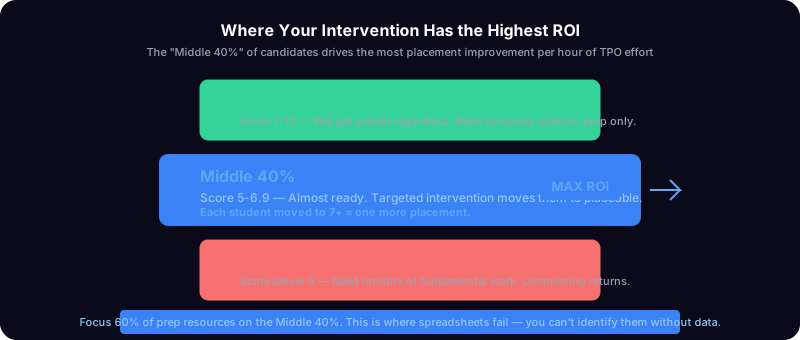
Tier A (Score 7-10) — 20% of batch: Already placeable. Focus on company-specific preparation — resume tailoring, company research, domain questions. Don't waste their time in general workshops.
Tier B (Score 5-6.9) — THE MIDDLE 40%: This is your highest-ROI group. Each student moved from 6 to 7+ is one additional placement. Focus interventions on their weakest single dimension:
- Low communication → GD sessions, presentation practice
- Low technical → Problem-solving workshops, peer coding
- Low confidence → Mock interview rounds with progressive difficulty
Tier C (Score below 5) — Bottom 40%: Hard truth: most Tier C students need 3-6 months of fundamental work. In a 4-week window, pair them with Tier A students for peer learning and focus on building basic confidence. Some will make dramatic improvement; most need longer timelines.
The math: In a 500-student batch with 38% readiness, moving just 50 students from Tier B to Tier A (a 10% shift) takes your placement rate from 38% to 48%. That's 50 more students placed from the same companies visiting campus.
Week 4: Mock Placement Drive
Run a full simulation:
- Panel interview format — 2-3 staff per panel, mimicking real placement drives
- Time-boxed — 20 minutes per candidate (companies typically give 15-25)
- Written feedback — structured scoring, not just "good" or "needs improvement"
- Updated readiness scores — compare against Week 1 baseline
This serves two purposes:
- Gives every candidate real interview experience before the actual drive
- Gives you fresh readiness data — you now know who improved and who didn't
The 3 Metrics That Predict Placement Success
You don't need a dashboard with 50 charts. Track these three numbers weekly:
1. Readiness Percentage
Readiness % = (Candidates with avg score ≥ 7) / Total active candidates × 100
This single number tells you more about your batch than any report. It's your north star metric.
Benchmarks: Below 30% = crisis. 30-50% = average Tier-2. 50-70% = strong. 70%+ = top performer.
2. Assessment Coverage
Coverage % = (Candidates with at least one assessment) / Total candidates × 100
If coverage is below 80%, you're flying blind. You can't improve what you don't measure. Many colleges assess only "star students" and ignore the middle — which is exactly where the ROI is.
3. Department Delta
Delta = Highest department readiness % - Lowest department readiness %
If CSE is at 60% readiness and Mechanical is at 25%, you know where to allocate resources. A 35-point delta means one department is being neglected.
How to track: Excel works for small batches. For 200+ candidates across multiple departments, a readiness tracking platform automates these calculations in real-time. Either way, share these numbers with your Dean weekly — nothing motivates resource allocation like data.
5 Mistakes That Kill Placement Rates
1. Starting Preparation in the Final Semester
By the 7th/8th semester, it's too late for fundamental improvement. Data from institutions using structured tracking shows that students assessed 6+ months before placement season have 40% higher readiness scores than those assessed in the final semester.
Fix: Start baseline assessments in the 5th or 6th semester. Even one assessment creates visibility.
2. Preparing Everyone for IT Companies
Not every student should target IT services. A Mechanical Engineering student scoring 3/10 on coding but 8/10 on core domain knowledge should target manufacturing companies, not TCS.
Fix: Match preparation to realistic target companies based on branch, scores, and aptitude.
3. No Historical Data Year Over Year
Every academic year, most placement cells start from scratch — no records of what preparation methods worked, what scores correlated with selection, which companies hired from which departments.
Fix: Maintain a simple database (even a shared spreadsheet) that accumulates year over year. After 3 years, you'll have institutional memory that compound your results.
4. Ignoring the Middle 40%
The top 20% will get placed regardless. The bottom 20% need longer timelines. The middle 40% is where your intervention has the highest return — but you can only identify them with assessment data.
5. Workshops Without Measurement
Running 50 workshops per semester means nothing if you don't measure the outcome. Every preparation activity should have a before/after score comparison.
Fix: Assess before the workshop series. Assess after. If scores didn't move, the workshop wasn't effective — change the format.
What the Data Shows
Institutions that implemented structured readiness tracking report measurable improvements:
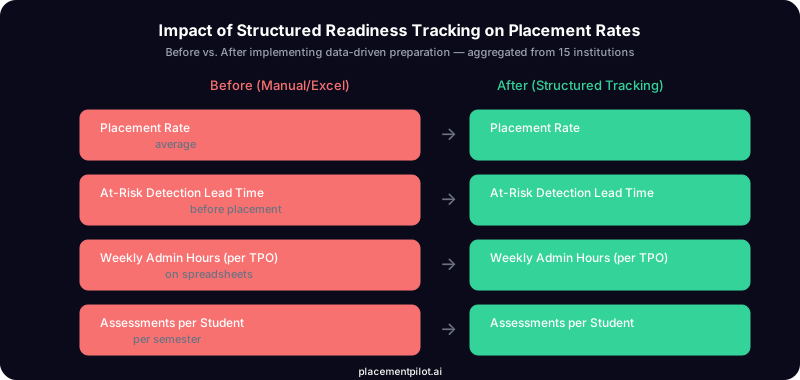
These numbers are aggregated from published outcomes and our own early-access institutional partners. The consistent pattern: visibility drives intervention, and intervention drives placement.
Getting Started This Week
You don't need to overhaul your entire process. Start with one action:
Assess 20 candidates this week. Use the 4-dimension scoring (communication, technical, problem solving, presentation). Use a 1-10 scale. Enter the scores in Excel, a readiness platform, or even a notebook.
Then look at the data and ask: "What does this tell me that I didn't know yesterday?"
That's the beginning of data-driven placement preparation.
Related: Best Placement Management Software for Indian Colleges | 5 Signs Your Placement Cell Needs a Digital Upgrade
Want to automate readiness tracking? Try PlacementPilot AI free — track up to 100 candidates, no credit card required.
Sources: AICTE Approval Process Handbook 2024-25, NIRF India Rankings 2024, India Skills Report 2025 (Wheebox), Aspiring Minds National Employability Report.