"We need AI for our placement cell."
If you're a TPO or placement officer at an Indian engineering college, you've probably heard this from your management at least once in the last year. Maybe the chairman read an article. Maybe a parent asked during orientation. Maybe AICTE's latest circular mentioned "AI-readiness" and now there's a committee.
But when people say "Placement AI," they mean very different things — and most of what's being sold under that label isn't what your placement cell actually needs.
This article breaks down what Placement AI genuinely means for Indian colleges, distinguishes hype from utility, and helps you evaluate whether any of it is worth your time and budget.
The Scale of the Problem AI Is Supposed to Solve
India's placement challenge is unlike anything in the world. Consider the numbers:
- 10,000+ AICTE-approved technical institutions across the country (AICTE Approval Process Handbook 2024-25)
- 15 lakh engineering graduates entering the job market every year
- 51.25% employability rate among Indian graduates (India Skills Report 2025, Wheebox)
- 72% of engineering colleges place fewer than 40% of their students (NIRF 2024 data)
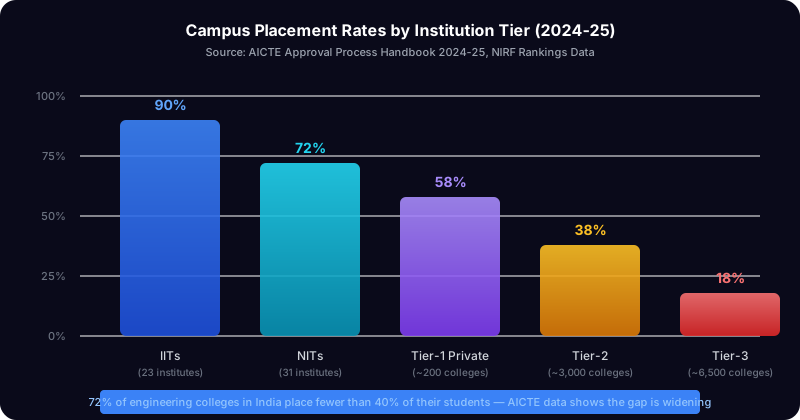
That means roughly 7.3 lakh engineering graduates every year are essentially unemployable at the point of graduation. Not because jobs don't exist — NASSCOM projects 4.5 lakh IT hires alone in 2025-26 — but because there's a massive gap between what students can demonstrate and what companies expect.
This is the gap "Placement AI" claims to close. The question is: can it?
Two Very Different Meanings of "Placement AI"
When vendors say "AI for placements," they typically mean one of two things. These are fundamentally different products solving fundamentally different problems.
1. AI for Recruiting: Matching Companies to Candidates
This is the more established category. Think of it as the Naukri or LinkedIn model applied to campus recruitment:
- Resume parsing — extracting skills, CGPA, and experience from uploaded resumes
- Job-candidate matching — algorithmic scoring of how well a student fits a job description
- Recruiter dashboards — helping companies filter 500 candidates down to 50 for interviews
- Chatbots — answering student queries about application status
This type of AI helps after students are ready. It makes the logistics of connecting companies to candidates more efficient. Platforms like Superset and HirePro operate primarily in this space.
The limitation: If your students aren't ready for interviews, better matching algorithms won't help. You'll just match unready students to companies faster — which damages your college's reputation with recruiters.
2. AI for Readiness: Preparing Students for Placements
This is the newer, less glamorous, but arguably more impactful category:
- Readiness tracking — scoring students on communication, technical knowledge, problem-solving, and presentation using structured assessments
- Resume analysis — not just parsing, but evaluating whether a resume would pass an initial HR screen
- Mock interview analysis — identifying patterns in how students perform under interview conditions
- Predictive analytics — flagging students who are at risk of being unplaced based on their assessment trajectory
- Cohort insights — showing which departments, batches, or skill dimensions need the most intervention
This type of AI helps before companies arrive on campus. It gives TPOs the visibility to intervene early and direct limited training resources where they'll have the most impact.
If you're at a Tier-2 or Tier-3 college, this is probably what you actually need. Your bottleneck isn't that companies can't find your students. It's that your students aren't ready when companies come looking. We wrote about this distinction in detail in our guide on how to improve your campus placement rate.
What Placement AI Can Actually Do (Today, Not in a Pitch Deck)
Let's be specific about what's real and what's marketing. Here's an honest assessment of AI capabilities relevant to Indian placement cells in 2026.
Genuinely Useful Right Now
Readiness scoring from structured assessments. When trainers score students on defined dimensions (communication, technical depth, problem-solving, presentation), AI can aggregate these into meaningful readiness scores, identify trends, and flag students whose scores are declining. This isn't cutting-edge AI — it's applied statistics done well. But it replaces hours of Excel work that most TPOs currently do manually, if they do it at all. Our readiness metrics guide explains how these scores work in practice.
Resume quality analysis. AI can evaluate whether a resume follows professional formatting conventions, has quantified achievements, and covers the key sections recruiters look for. It won't tell you if a student is a good candidate, but it will catch the obvious problems — typos, missing contact information, unexplained gaps, generic objective statements — that cause resumes to get rejected in the first 10 seconds.
Batch-level analytics. Instead of manually compiling department-wise and batch-wise placement readiness data, AI-driven dashboards can show you in real time which cohorts are falling behind. For a TPO managing 500-2,000 students across multiple departments, this is the difference between informed action and reactive firefighting.
Interview scheduling and logistics. Not glamorous, but genuinely helpful. AI can optimize interview slot allocation, match interviewer availability with candidate schedules, and reduce the coordination overhead that eats up TPO time during placement season.
Promising but Still Maturing
AI-powered mock interviews. Several platforms now offer AI-driven mock interview practice where students interact with an AI interviewer. The technology is impressive but has limitations: it can assess communication fluency and structure but struggles with evaluating technical depth in domain-specific contexts. It's a useful supplement to human mock interviews, not a replacement.
Predictive placement analytics. The idea of predicting which students will or won't get placed based on early assessment data is compelling. However, prediction accuracy depends heavily on historical data quality — something most Indian colleges don't have yet because they haven't been tracking structured assessment data for long enough. As more colleges adopt systematic tracking, these models will improve. But right now, treat predictions as directional indicators, not certainties.
Overhyped or Premature
"AI that guarantees improved placement rates." No tool can guarantee this. Placement rates depend on student quality, company participation, market conditions, location, college reputation, and a dozen other factors no software controls. Any vendor making guarantees is selling you a story, not a product.
Fully autonomous AI placement officers. The idea that AI can replace the TPO's judgment, relationships with recruiters, and understanding of institutional context is fantasy. AI is a tool that amplifies what a good placement officer can do. It doesn't replace the officer.
One-click company-student matching that "solves placements." Matching algorithms are only as good as the data going in. If student profiles are incomplete, assessments are unstandardized, and company requirements are vague, the matching will be mediocre regardless of how sophisticated the algorithm is.
How to Evaluate Placement AI for Your College
If you're considering adopting AI-driven tools for your placement cell, here are the questions that actually matter:
1. Does It Solve a Readiness Problem or a Logistics Problem?
If your placement rate is below 50%, you almost certainly have a readiness problem. Look for tools that help you assess, track, and improve student preparedness — not just tools that make recruitment logistics smoother.
If your placement rate is already above 70%, you might benefit more from recruiting-side AI that helps you connect with a wider range of companies.
Most Indian engineering colleges are in the first category. See the full comparison of placement management tools for how different products address these needs.
2. Can You Actually Use It With Your Current Staff?
A tool that requires a dedicated tech team to operate is useless for a placement cell with 2-3 staff members. Ask for a demo with realistic data volumes — 500 students, 5 departments, 3 staff members doing assessments. If it takes more than a day to learn, it's not built for your context.
3. What Does It Cost Relative to Your Budget?
Enterprise AI platforms can cost ₹1-2 lakh per month. That's feasible for an IIT or a large private university. For a Tier-2 college with 800 students and a placement cell budget of ₹50,000/month, you need tools that deliver value at ₹5,000-15,000/month or less.
The PlacementPilot pricing page shows what we think fair pricing looks like for this market — we built our plans specifically for the Tier-2/3 budget reality.
4. Does It Work Without Perfect Data?
Your first semester using any new tool will have incomplete data. If the AI features only produce useful outputs when every student has 5+ assessments, a complete profile, and 3 mock interviews logged, it won't help you in Year 1. Look for tools that deliver value incrementally — even with partial data.
5. Is the "AI" Actually AI or Just a Dashboard?
This sounds cynical, but it's a real concern. Some platforms label standard database queries and charts as "AI-powered analytics." There's nothing wrong with good dashboards — they're valuable. But don't pay an AI premium for filtered SQL queries with a gradient background.
Real AI in this context means: pattern recognition across student performance data, natural language processing for resume analysis, or machine learning models that improve predictions as more data flows in. Ask vendors to explain specifically what their AI does that a well-designed spreadsheet formula couldn't.
The Honest Case for Placement AI
Here's what we believe after building PlacementPilot and working with placement cells across India:
AI won't fix your placements. Your staff, your preparation programs, your relationships with companies, and your students' effort will fix your placements.
What AI can do is give you visibility you've never had. It can tell you, in real time, that 43% of your CSE batch has below-average communication scores and needs targeted workshops. It can flag that a particular student's assessment scores are trending downward before it's too late to intervene. It can show your Dean a department-level readiness dashboard instead of making you compile data for two days before a review meeting.
That visibility — knowing where you stand, who needs help, and whether your interventions are working — is what separates a 38% placement rate from a 65% placement rate. We detailed the mechanics of this in our data-driven approach to improving placement rates.
The best placement officers we've met already have this instinct. They know which students need help. They know which departments are lagging. AI doesn't replace that instinct — it scales it. It means you can have that level of awareness across 1,500 students instead of 50.
Getting Started Without a Big Budget
You don't need to commit to an expensive platform to start using AI-assisted placement preparation:
-
Start with structured assessments. Even in a spreadsheet, scoring every student on 4 dimensions (communication, technical, problem-solving, presentation) on a 1-10 scale gives you a foundation. Our readiness metrics guide explains the methodology.
-
Track over time. One assessment is a snapshot. Three assessments over 6 weeks show you a trajectory. That trajectory is where AI becomes useful — identifying who's improving, who's stagnating, and who's declining.
-
Adopt tooling incrementally. You can start with PlacementPilot's free tier to manage candidates and assessments, then add AI features as your data matures. See our solutions for colleges for how this works in practice, or request early access if you want to explore what's possible.
-
Measure outcomes. Whatever tool you adopt, track your placement rate, average time-to-placement, and company return rate. If the tool isn't moving these numbers after one placement season, reassess.
The Bottom Line
"Placement AI" is a real category with genuine utility — but it's also a term that gets stretched to cover everything from basic dashboards to speculative promises about fully automated placement offices.
For most Indian engineering colleges, the highest-impact use of AI in placements is not matching students to companies. It's giving TPOs real-time visibility into student readiness so they can intervene early, direct resources efficiently, and walk into placement season knowing — not guessing — where their batch stands.
That's not a revolution. It's a tool upgrade. And sometimes a good tool upgrade is exactly what makes the difference.
PlacementPilot AI is built specifically for Indian placement cells managing 100-5,000 students. Explore our features or see pricing to evaluate whether it fits your college's needs.